
"For 2010-11 and beyond, the Kirit Parikh report will be the benchmark. The report is being studied.These decisions are politically sensitive issues and have to be sustained over a period of time," Petroleum Secretary S Sundareshan told Business Standard. "It is impossible to insulate the Indian consumer against the movement in international oil prices."

There is scepticism in some quarters that the Budget for 2010-11, while spreading cheer, may be skating on thin ice. For instance, some of its assumptions will give way if the non-tax revenue projections turn out to be castles in the air.
Disinvestment proceeds of the government could be higher than the estimate of Rs 25,000 crore for 2009-10. The government has already raised Rs 13,621 crore through disinvestment in four public sector companies.Dilution of stake in National Mineral Development Corporation, the fifth public sector undertaking to come out with a public offer this year, is likely to fetch the government more than the remaining Rs 11,388 crore, thereby exceeding even the revised target.

'Prices can be adjusted now. The government can even temporarily cut taxes'.

This comes at a time when the country's total commercial energy requirement is expected to grow at 5-6 per cent to a massive 1,667 million tonne oil equivalent (Mtoe) required to achieve and sustain a 9 per cent gross domestic product growth rate in the next two decades, as per planning commission's projection.
PFC provides loan syndication, along with 18 other institutions, mostly banks and Life Insurance Corporation and Hudco, under the Power Lenders' Club.

The government may take the first step towards fiscal consolidation in Budget 2010-11 by partially rolling back tax cuts given to the industry last year. The service tax rate may be restored to 12 per cent, while excise duty could be increased marginally.

The ministry of urban development has asked the finance ministry to lower the duty in order to promote the public transportation system in the country.
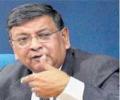
Mitra will take over from P V Bhide after January 31.
The government may take the first step towards fiscal consolidation in Budget 2010-11 by partially rolling back tax cuts given to the industry last year. The service tax rate may be restored to 12 per cent, while excise duty could be increased marginally.
As the ministry of finance gets into the Budget mode, its officials perhaps want to tell themselves, "All is well". So, they have none other than Aamir Khan, alias Rancho of recent Bollywood blockbuster 3 Idiots, talking to them this weekend on Cinema and Society.

While Finance Minister Pranab Mukherjee is aiming for a return to the path of fiscal prudence, various departments of the central government appear to be out of sync.
The government's initiative to set up a high-capacity power transmission link between India and Sri Lanka is likely to be completed by 2013.

A fresh $1-billion (nearly 4,600-crore) loan from the World Bank under the Jawaharlal Nehru National Urban Renewal Mission (JNNURM), to be routed through the Union government, would be linked to cities adopting certain efficiency parameters.

The government is likely to ease the incidence of minimum alternate tax, or MAT, on infrastructure companies.

It not only wants the ministry of petroleum and natural gas to rework the under-recovery figure for the current year but has also decided to look at the issue of oil subsidies only in February 2010, when the next Budget will be announced.

They want more cash, forex, higher bond coupons and increase in market prices for petrol, diesel, LPG.

Coal-based generators plan upgrades, clean tech over 5 years.
Power is one of the six major sectors contributing to the country's infrastructure in addition to cement, steel, coal, crude oil and petroleum products. The growth of these sectors account for more than a quarter in the IIP.
The ministry of petroleum and natural gas would be issuing instructions for fresh gas allocation from D6 this week.
 © 2026 Rediff.com - Investor Information - Advertise with us - Disclaimer - Privacy Policy - Sitemap - Feedback - About us - Terms of use - Grievances